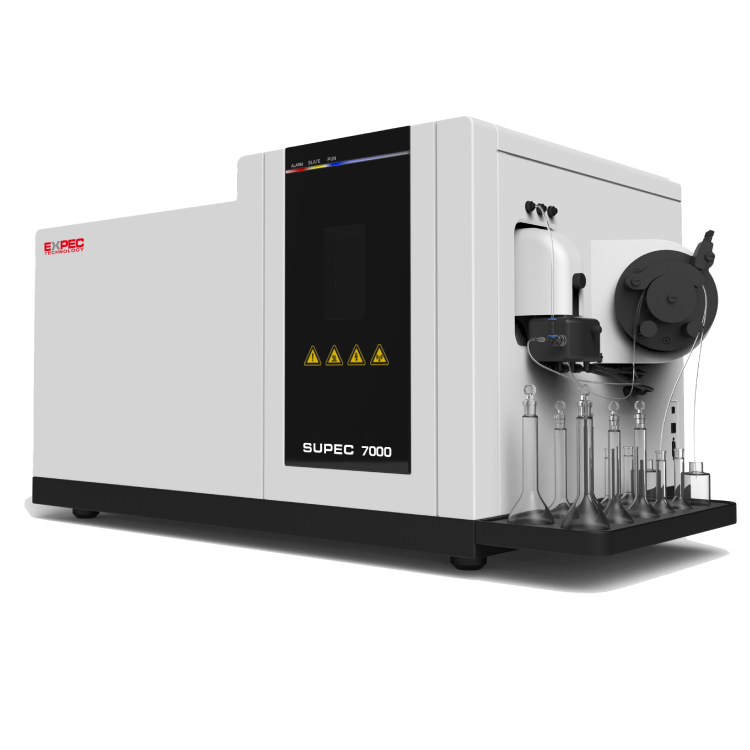
The FPI SUPEC-7000 ICP-MS has successfully resolved the core technology challenges associated with mass spectrometry, including high-temperature gas flow control, multi-stage gradient vacuum, highly sensitive ion interfaces, a distributed collision cell, and a temperature- and humidity-resistant quadrupole mass analyser, among others. The FPI SUPEC-7000 ICP-MS boasts excellent sensitivity, a lower detection limit, superior stability and a wider dynamic linear range, making it ideal for the analysis of trace elements in a diverse range of samples.
FPI SUPEC-7000 inductively coupled plasma mass spectrometer offers high sensitivity and reliability.
The SUPEC-7000 ICP-MS was developed following the resolution of core technical challenges in mass spectrometer, including the control of high-temperature gases, the utilization of multistage gradient vacuums, the integration of high-sensitivity ion interfaces, the incorporation of distributed collision reaction cells, and the incorporation of a quadrupole mass analyzer with temperature and humidity resistance.
This is combined with a liquid chromatography system, an online gas dilution system, automatic rapid injection, oxy-combustion, laser ablation, direct injection in atmosphere, organic injection, and other specialized technologies, and is suitable for a variety of professional applications. The combination of Element V, a professional mass spectrometer software system, with a standard methodology library, automatic tuning, guided operation mode and visualised status monitoring at any time greatly simplifies the operation of the mass spectrometer software system, while meeting the extensive needs of laboratory applications.
Elemental speciation analysis
Soil
According to the limit requirements of various heavy metals in the soil specified in EPA 3050 Band EPA 3051B, SUPEC-7000 is used to determine the content of metal elements in standard soil samples, and the matrix effect of soil samples is eliminated by bismuth, indium and antimony internal elements, and the interference correction equation and collision reaction cell are adopted.Technology eliminates interference from isobaric
O Rare earth element analysis has always been an important field of chemical analysis. Accurate determination of the content of rare earth elements and the interrelationship between elements are of great significance for determining the rock sedimentary environment and searching for rare earth deposits.Inductively coupled plasma mass spectrometry (lCP-MS) is widely used in the detection of trace elements in geological samples, mineral products and water sediments due to its high sensitivity and ow detection interference.
The EPA Method 200.8: ‘Determination of Trace Elements in Waters and Wastes by inductively Coupled Plasma Mass Spectrometry’ especially involves ultra-trace amounts of barium, cadmium, chromium, mercury,s trontium, barium, etc. Measurement of these elements requires the instrument to have excellent sensitivity.The SUPEC-7000 can perform accurate measurement of multiple elements in the laboratory, and can be carried by the vehicle to the emergency site to complete the analysis of the above elements.
Excellent sensitivity
With an innovative aerodynamic simulation design that enhances the ion interface at the junction of thermal plasma and vacuum, the sensitivity of ICP-MS is significantly improved by 3 to 5 times. This advancement allows for detection limits as low as parts per trillion (ppt), making it ideal for analyzing high-purity materials and reagents.
Multiple Applications
As a rapid multi-element analysis technique widely utilized in industries that require analysis of large quantities of samples and measurement of multiple elements within each sample. ICP-MS industries include environmental monitoring (river water, drinking water, estuary and sea water, waste, soil and sediment digests, biological communities, etc.), routine food safety testing, pharmaceutical material analysis, and consumer product testing (toys, textiles, etc.). Other industries with widespread applications of ICP-MS include semiconductor and fine chemical manufacturing, life sciences, clinical research, geochemistry, mining, nuclear science, materials research, metrology, and academia.
Ready to enhance your operations with industry-leading online analysis solutions? Get in touch for expert guidance, pricing, or a personalized demo.
Send Your Inquiry Today