Home / Product / Salinity Sensor

Salinity Sensor

The salinity online sensor adopts the four-electrode method and is equipped with a built-in NTC temperature sensor and compensation algorithm, enabling automatic temperature compensation for accurate measurements. The sensor uses an RS485 interface and supports the standard Modbus protocol.

Downloads and Resources

Get A Quote Now
Description

Product Overview

When measuring a sample, the salinity sensor first obtains an accurate conductivity value, which is then converted into salinity through an internal algorithm.
Conductance or resistance is determined by measuring the current and voltage across the electrodes of the conductivity cell. Conductance (G) is defined as the reciprocal of resistance:

G = 1 / R = I / V

The conductance value depends on the geometry of the electrode plates and is represented by the cell constant (K), which is the ratio of the distance between the electrodes (L) to the electrode surface area (A):

K = L / A

Where:

  • K — Cell constant of the conductivity electrode
  • A — Effective area of the electrode plates
  • L — Distance between the electrode plates

This value is known as the cell constant and can be calculated based on the electrode’s physical dimensions. For example, if two square electrode plates each have an area of 1 cm² and are spaced 1 cm apart, the cell constant is K = 1 cm⁻¹.
If the measured conductance (G) using this electrode is 1000 μS, then the conductivity of the solution is:

κ = 1000 μS/cm

Conductance can be converted into standardized conductivity (κ), which is independent of the electrode configuration. This is done by multiplying the conductance by the cell constant:

κ = G × L / A = G × K

This conductivity value is then used to calculate salinity through predefined conversion formulas within the sensor.

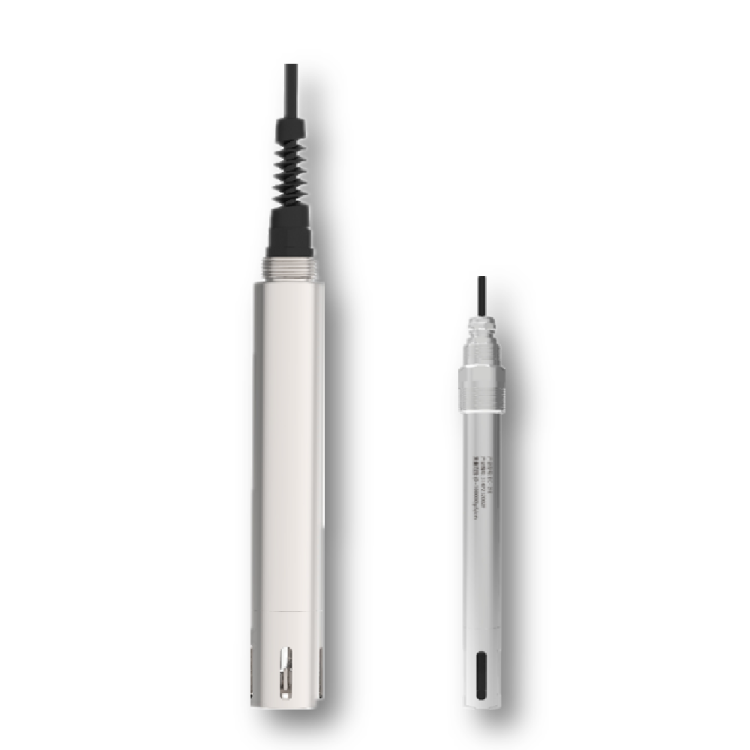
Salinity Sensor Technical Specificationsh

Versatile Applications Across Industries

  • Surface water
  • Industrial wastewater
  • Industrial process water
  • Swimming pools
  • Seawater

Key Features of Salinity Sensor

  • Stable cell constant, unaffected by polarization
  • Equipped with temperature compensation, suitable for a wide range of environments
  • Simultaneous output of conductivity, salinity, TDS, and temperature parameters
  • Corrosion-resistant housing with IP68 waterproof rating for long-term underwater operation
  • RS485 communication interface with standard Modbus protocol for easy integration

Why Salinity Sensor Stands Out

Frequently Asked Questions

Get A Quote Now

Unlock Precision Analysis with Salinity Sensor

Ready to enhance your operations with industry-leading online analysis solutions? Get in touch for expert guidance, pricing, or a personalized demo.

Related Products

Send Your Inquiry Today

Fill out the form below, and we will be in touch shortly.
Contact Information
Project Details