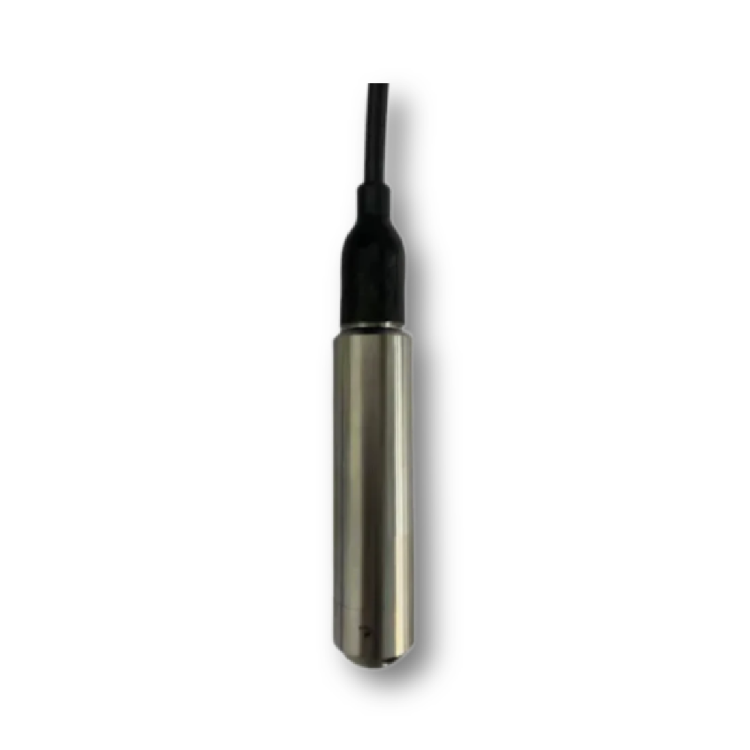
When the submersible level transmitter is immersed in a certain depth of the measured liquid, the sensor is subjected to the pressure from the liquid surface. This pressure is transmitted to the positive pressure chamber of the sensor through a gas-conducting stainless steel tube. At the same time, the atmospheric pressure P0 above the liquid surface is introduced into the negative pressure chamber of the sensor to offset the atmospheric pressure on the back of the sensor. Thus, the sensor effectively measures the pressure:
P=ρ⋅g⋅H
By measuring the pressure P, and based on the principle that the static pressure of a liquid is proportional to its depth, the sensor uses a capacitive pressure sensing element to convert the hydrostatic pressure into an electrical signal. This signal is then processed with temperature compensation and linear correction, and finally converted into a standard output signal.
P+P0=P0+ρ⋅g⋅H
Where:
- H: Depth of the level sensor immersed in the liquid
- ρ: Density of the measured liquid
- g: Gravitational acceleration (constant)
- P0: Atmospheric pressure