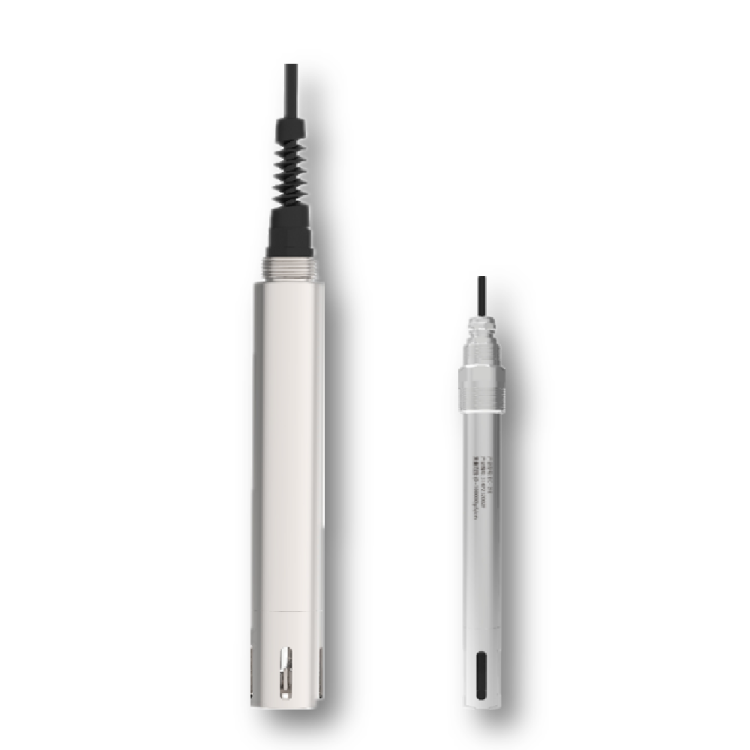
When measuring a sample, the salinity sensor first obtains an accurate conductivity value, which is then converted into salinity through an internal algorithm.
Conductance or resistance is determined by measuring the current and voltage across the electrodes of the conductivity cell. Conductance (G) is defined as the reciprocal of resistance:
G = 1 / R = I / V
The conductance value depends on the geometry of the electrode plates and is represented by the cell constant (K), which is the ratio of the distance between the electrodes (L) to the electrode surface area (A):
K = L / A
Where:
- K — Cell constant of the conductivity electrode
- A — Effective area of the electrode plates
- L — Distance between the electrode plates
This value is known as the cell constant and can be calculated based on the electrode’s physical dimensions. For example, if two square electrode plates each have an area of 1 cm² and are spaced 1 cm apart, the cell constant is K = 1 cm⁻¹.
If the measured conductance (G) using this electrode is 1000 μS, then the conductivity of the solution is:
κ = 1000 μS/cm
Conductance can be converted into standardized conductivity (κ), which is independent of the electrode configuration. This is done by multiplying the conductance by the cell constant:
κ = G × L / A = G × K
This conductivity value is then used to calculate salinity through predefined conversion formulas within the sensor.